


The owner of a “self-service” bookstore in Taipei said she is interested in how readers interact with books in the absence of staff.
Wu Ya-hui (吳雅慧), the second-generation owner of Rare Books (舊香居), which specializes in antiquarian books, opened the store on Xinhai Road in July last year as an experiment.
Stocked with more than 20,000 secondhand books, a sign on one wall tells customers how to pay. The books are priced at either NT$50 or NT$100, with the exception of special titles. Payment is cash only.

Photo: Liao Chen-huei, Taipei Times
Rare Books, which she has run with her father for many years, has become a popular tourist attraction, but Wu said she was nervous about opening a self-service bookstore.
“I did not know if this [concept] was feasible,” she said. “But the challenge itself was fun and interesting, and we are very optimistic about human nature.”
Wu said she believes the simply decorated bookstore would attract book lovers.
Many of Rare Books’ old customers, who have more books than their homes can hold, brought boxes of books to the store in the hopes that they could be sold, she said.
Out-of-print antique books were put in Rare Books’ stock, while the rest were kept in storage, she said.
Her family did not want the books to be “lonely,” so they decided to open a self-service bookstore to give people a chance to buy a book they want to read at an affordable price, she said.
While others in the book business were surprised by the approach, Wu said she believes bookstores should return to their original purposes, with books being used as much as possible.
Instead of keeping books on bookshelves or stacked in storage, they might as well be put into the hands of readers, she said.
The rent for the self-service shop is NT$60,000 per month, but that does not include utilities, security system costs and other fees, she said.
However, she is not trying to make a profit, she just hopes the sales will cover the rent, she said.
That means the store just needs to sell 600 books, at NT$100 each, to make the rent, she said.
Since Rare Books has a good reputation for selecting books, many people bought boxes of books from the self-service store after it opened.
Books at the self-service store range from philosophy books published 30 years ago to young adult literature and volumes by food writer Tang Lu-sun (唐魯孫).
A writer who lives close to the store treats the bookstore as their “private library” when they need material, Wu said.
The store has already formed its own “ecosystem,” as customers can discuss books with others or quietly “search for treasures” in the shelves, she said.
At the beginning of the month, Wu launched another “experiment,” keeping the self-service store open all day and all night on Friday and Saturday.
She tested the new hours on Dec. 31, and the result was that readers marked the start of a new year with a book, she said.
Unknown adventures make life interesting, so if she can bring books into people’s lives, then “why not,” she said.

Yangmingshan National Park authorities yesterday urged visitors to respect public spaces and obey the law after a couple was caught on a camera livestream having sex at the park’s Qingtiangang (擎天崗) earlier in the day. The Shilin Police Precinct in Taipei said it has identified a suspect and his vehicle registration number, and would summon him for questioning. The case would be handled in accordance with public indecency charges, it added. The couple entered the park at about 11pm on Thursday and began fooling around by 1am yesterday, the police said, adding that the two were unaware of the park’s all-day live

A former soldier and an active-duty army officer were yesterday indicted for allegedly selling classified military training materials to a Chinese intelligence operative for a total of NT$79,440. The Taipei District Prosecutors’ Office indicted Chen Tai-yin (陳泰尹) and Lee Chun-ta (李俊達) for contravening the National Security Act (國家安全法) and the Anti-Corruption Act (貪污治罪條例). Chen left the military in September 2013 after serving alongside then-staff sergeant Lee, now an army lieutenant, at the 21st Artillery Command of the army’s Sixth Corps from 2011 to 2013, according to the indictment. Chen met a Chinese intelligence operative identified as “Wang” (王) through a friend in November

Minister of Digital Affairs Lin Yi-ching (林宜敬) yesterday cited regulatory issues and national security concerns as an expert said that Taiwan is among the few Asian regions without Starlink. Lin made the remarks on Facebook after funP Innovation Group chief executive officer Nathan Chiu (邱繼弘) on Friday said Taiwan and four other countries in Asia — China, North Korea, Afghanistan and Syria — have no access to Starlink. Starlink has become available in 166 countries worldwide, including Ukraine, Malaysia, the Philippines and Vietnam, in the six years since it became commercial, he said. While China and North Korea block Starlink, Syria is not
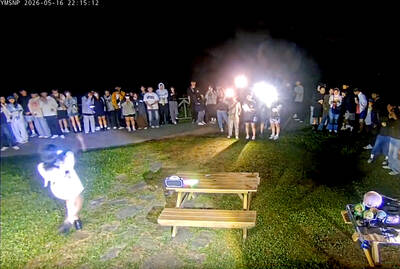
Yangmingshan National Park’s Qingtiangang (擎天崗) nature area has gone viral after a park livestream camera observed a couple in the throes of intimate congress, which was broadcast live on YouTube, drawing large late-night crowds and sparking a backlash over noise, bright lights and disruption to wildlife habitat. The area’s livestream footage appeared to show a couple engaging in sexual activity on a picnic table in the park on Friday last week, with the uncensored footage streamed publicly online. The footage quickly spread across social media, prompting a tide of visitors to travel to the site to “check in” and recreate the


 RSS
RSS